A condenser in Fort Bend County works a schedule that national equipment averages were not written for. Describe what the system is doing and get connected with an independent, TDLR-licensed air conditioning contractor working in Sugar Land and Fort Bend County.
Fort Bend County sits in IECC and ASHRAE Climate Zone 2A — hot and humid. The average first 90°F day is 6 May, the average last is 8 October, and the county records roughly 89 days a year at or above 90°F and 27 at or above 95°F. Houston logged 4,099 cooling degree days in 2025, against 961 heating degree days.
That means a Sugar Land condenser accumulates far more compressor hours per calendar year than the same model installed in a four-season market. Manufacturer lifespans and the national "10 to 15 years" figure are averages across all of those markets. Locally they land at the short end, and the parts that fail first are the ones that cycle: capacitors, contactors, fan motors and the compressor itself.
Humidity does the rest. A Gulf Coast summer means an evaporator coil is wet for months at a stretch, which is why the condensate side of the system fails as often as the electrical side. What Sugar Land does not have is salt-air corrosion — that is a Galveston and Bay Area problem, and the city is more than fifty miles inland. Any contractor who leads with coastal corrosion here is reading from a template written for somewhere else.
The single most common summer failure, and the cheapest. Heat degrades it, and a weak one shows up as a compressor that hums and will not start, or a system that trips its breaker on start-up.
An electromechanical switch that closes every time the system starts. In a market where the system may start twenty times a day for five months, its contacts pit and burn.
Runs whenever the compressor does. When it fails, head pressure climbs and the compressor is next, which is why a fan motor is a genuinely urgent repair rather than a cosmetic one.
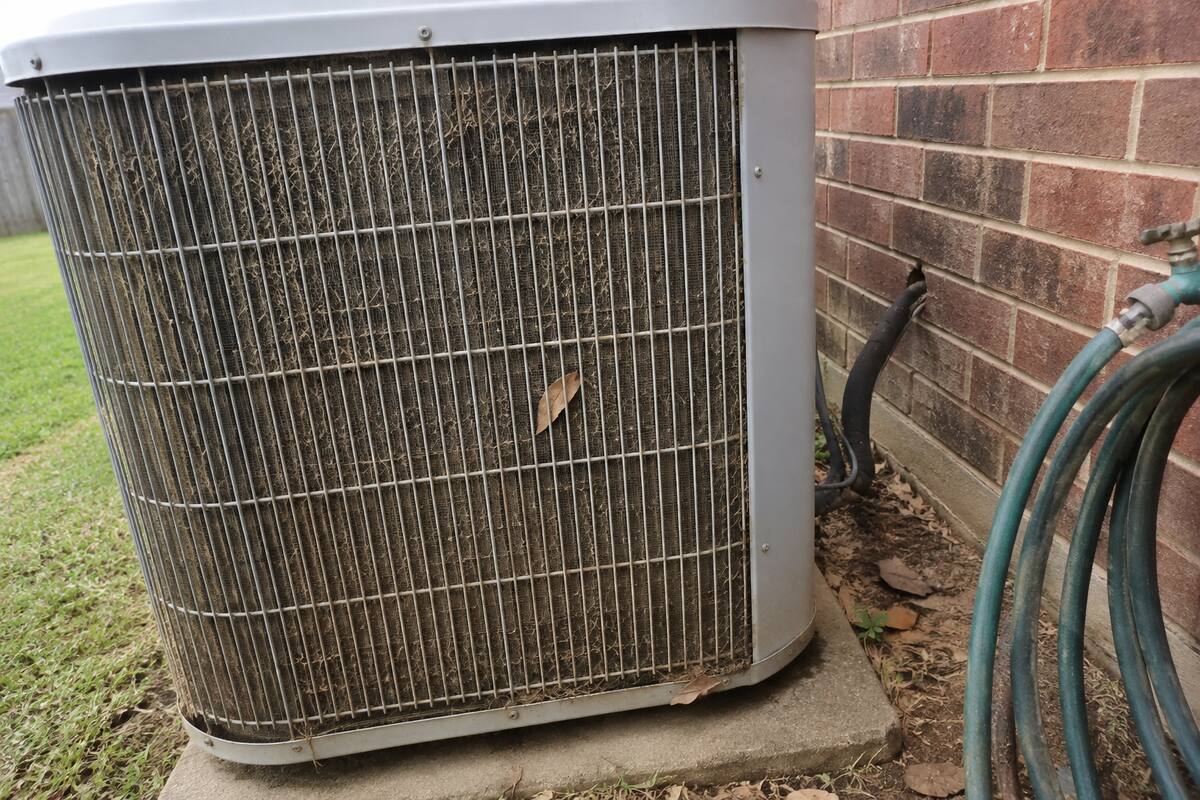
Fins packed with grass clippings, cottonwood and dust. The unit is trying to dump heat into 98°F air already; a blocked coil takes away what little margin it had.
Low charge is a symptom, not a diagnosis. Adding refrigerant without finding the leak means paying for it again next season — and on an R-22 system, paying reclaimed-stock prices for it.
Not a cooling failure at all until the float switch shuts the system down, which is exactly what it is there to do. See attic air handlers and drain lines.
Neither of these is a repair and neither requires a license. The filter: a filter that has not been changed since spring restricts airflow enough to freeze an evaporator coil, and a frozen coil produces warm air at the vents — a symptom that looks exactly like a refrigerant failure. The breaker: air handlers and condensers are usually on separate circuits, and a tripped condenser breaker gives a house that blows air but never cools. A breaker that trips again immediately is not a reset problem; leave it off and describe that on the call, because it changes what the contractor brings.
If the indoor coil has frozen, switching the system to fan only for a couple of hours will thaw it and often restores cooling temporarily. It does not fix why it froze. Restricted airflow and low refrigerant charge are the two usual causes and they need opposite responses.
Two numbers decide it more reliably than any rule of thumb: the age of the system and the cost of the repair against the cost of a changeout. Under about eight years, almost any repair is worth making. Past twelve, a repair that costs a third of a new system rarely is, because the rest of the equipment is the same age as the part that just failed. A compressor or a refrigerant-circuit failure on an R-22 system is effectively a replacement decision, since R-22 is only available reclaimed.
Because August is when it is asked for the most. A marginal capacitor, a partly blocked coil or a slightly low charge will carry a system through a mild May afternoon and fail on a 99-degree day when the compressor never gets to stop. The failure is usually months old by the time it becomes visible; the heat only exposes it.
The outdoor fan running does not mean the compressor is running, and neither means the refrigerant circuit is intact. Warm air at the vents with the blower working normally points at the refrigerant side or the compressor rather than at airflow. A frozen indoor coil produces the same symptom from the opposite cause, which is why it is diagnosed on gauges rather than by guessing.
Common Houston-area repairs run from a low three-figure capacitor or contactor replacement up into four figures for a compressor or an evaporator coil. What varies most is diagnostic and after-hours pricing, so it is worth asking for the diagnostic fee, the hourly or flat rate, and whether the diagnostic is credited against the repair — before anyone is dispatched.
Describe the symptom and the age of the system. Getting connected with an independent Sugar Land AC contractor takes one call.
Call (281) 672-8034 Request a Quote Sugar Land