Home › Services › Furnace Replacement
A no-heat call on a fifteen-year-old system in November is rarely a repair. Because the furnace and the air conditioning share an air handler and ductwork in a Sugar Land house, it is usually a conversation about the whole system — held in October rather than July, which makes it a better conversation.
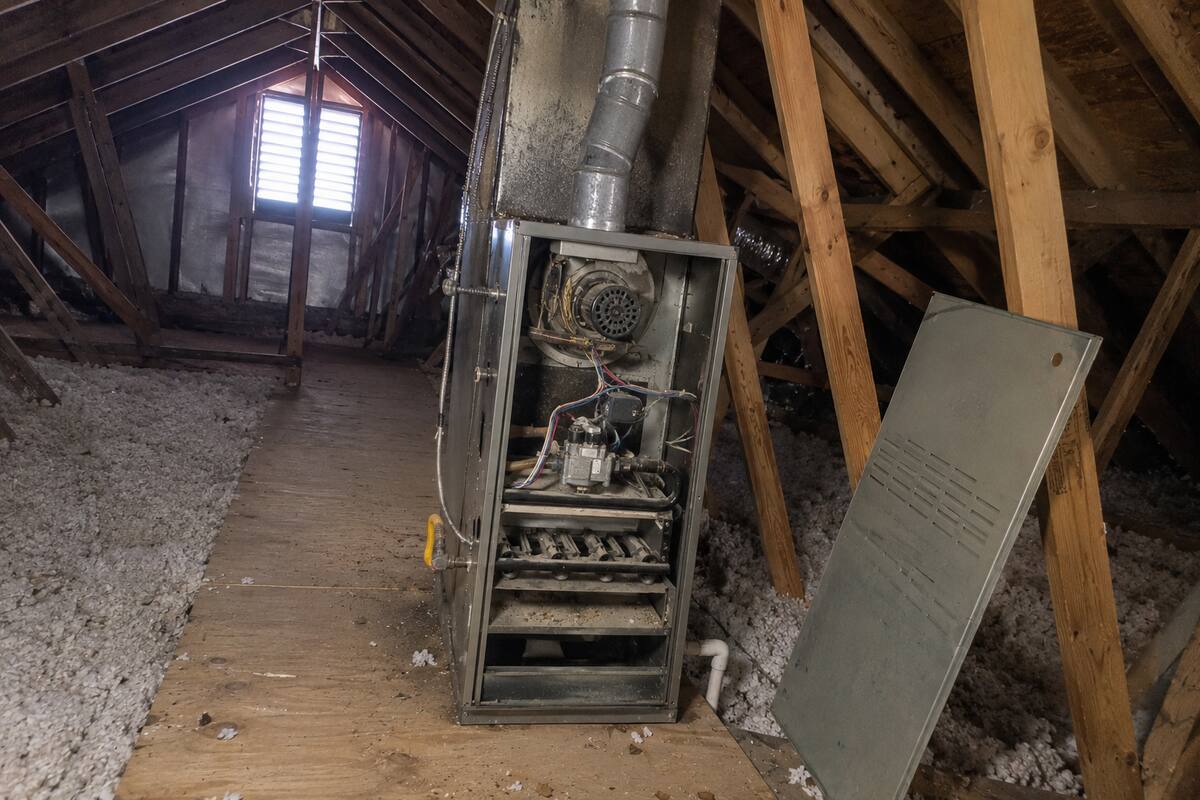
In a slab-on-grade house the heating and cooling sides are not two machines. The furnace or air handler, the evaporator coil and the ductwork are one stack in one attic, and they are almost always the same age. So a heating failure on a system in its mid-teens raises an obvious question: is it sensible to spend on the heating half of a system whose cooling half is on the same clock, and whose coil uses a refrigerant that is being phased down anyway?
Often it is not, and the timing works in the homeowner's favor. The house is not at 88 degrees, contractors are not triaging a heat wave, and there is room to get more than one quote. The same conversation in July is compressed into an afternoon.
A furnace, a coil and a condenser installed together in 2009 are three components with one date. Replacing one of them well does not make the other two younger.
Opening the refrigerant circuit on an R-22 system for any reason is a replacement conversation on price. R-410A is not stranded — the 2026 EPA reversal made that explicit. See refrigerant and system age.
If the ducts are leaking into an unconditioned attic, a new furnace inherits the same losses. This is the line item most often left out of a comparison between two quotes. See duct repair and sealing.
A high-efficiency condensing furnace produces its own condensate and needs a drain for it, in an attic that already has a condensate problem to manage. It also changes the venting arrangement.
Worth asking rather than assuming, especially where the house is all-electric or the gas run to the attic is awkward.
Sugar Land has adopted the 2024 International Codes and the 2023 NEC. The permit is pulled by the licensed contractor doing the work, not by you. Call (281) 672-8034 and the contractor you are connected with will confirm what your address needs. Sugar Land Permits & Inspections takes questions straight from homeowners, on (281) 275-2270.
First Colony, Commonwealth, New Territory and Greatwood cover the bulk of the 1980s and 1990s housing, which puts most of those houses on a second system installed in the 2000s — the exact vintage that produces a November no-heat call with a fifteen-year-old coil sitting above it. In Venetian Estates, Sugar Creek and Sugar Mill the heating equipment has usually been replaced more than once already, and the useful question is what the ductwork has been through rather than what the furnace has.
Sometimes, and it depends on the vintage and the configuration. The furnace and the evaporator coil usually share one cabinet stack in an attic installation, so replacing the furnace means the coil is opened, moved or replaced anyway. Where the AC side is close to the end of its own life, doing both at once avoids paying twice for the same access and the same labor. Where the AC is genuinely young, a furnace-only replacement is a reasonable thing to ask for.
For a planned changeout, yes, for reasons that have nothing to do with the equipment. Contractor availability in a Houston October and November is not what it is in a heat wave, the conversation is considered rather than panicked, and the decision is being made from a house that is comfortable rather than from a house at 88 degrees. A fall no-heat call on an old shared system is a replacement conversation held in the best possible conditions.
A genuine question in this climate rather than a foregone one. A heat pump uses the same equipment for both seasons and is efficient across most of a Houston winter; a gas furnace produces hotter supply air and is less affected by the coldest nights. Which is right depends on the existing ductwork, whether the house has a gas connection at all, the electrical service, and what the cooling side needs. See heat pump systems.
The equipment and its input rating; whether the evaporator coil is being replaced or reused, and with what refrigerant; what happens to the flue and the combustion-air arrangement; whether the condensate arrangement changes, since a high-efficiency furnace produces its own condensate as well as the AC side; the permit and inspection; and the two warranties, manufacturer and labor, as separate documents.
October is the month to have this conversation. Get connected with an independent Fort Bend County contractor and get the options in writing.
Call (281) 672-8034 Request a Quote Sugar Land