Home › Services › Heating & Furnace Repair
Houston runs about four times more cooling load than heating load, and none of that helps on the first genuinely cold night in November when a furnace that has not run since March is asked for full output at once. That night is when this trade gets its calls.
Houston recorded 961 heating degree days in 2025 against 4,099 cooling degree days — roughly a four-to-one ratio, and about three-to-one on long-run normals. On paper that makes heating a footnote. In practice it makes it a different kind of risk, because a Sugar Land furnace sits unused for seven to eight months a year and then gets asked to work perfectly, on demand, on one particular evening.
Over those idle months dust settles on the burner assembly and the flame sensor; gaskets and seals stiffen; the flue and the burner compartment become an attractive place for rodents to nest; and thermostat calibration drifts unnoticed because nothing has called for heat since spring. The trade rule of thumb is blunt and broadly accurate: a furnace is most likely to fail on the first cold night after sitting idle all summer. Houston's first genuinely cold night usually lands somewhere between late October and late November.
A thin rod that confirms the burner has lit. A summer of dust leaves a residue on it, the control board cannot see a flame, and the burner shuts down a few seconds after igniting. Cheap part, extremely common fault.
Brittle by design and degraded by every cycle it has ever run. When it fails there is no ignition at all — the blower may still run, which is why the house sometimes gets colder rather than staying level.
A burner compartment or flue is dark, sheltered and undisturbed for most of the year. Fort Bend attics have plenty of soffit and fascia gaps, which is where the roofing side connects to this one.
A blocked or restricted flue prevents the pressure switch from closing and locks the system out. This is a safety interlock doing its job, not a nuisance fault to be bypassed.
A setting or a wire that has been wrong since March and only becomes visible when something calls for heat. See thermostats and controls.
The one that is not a comfort problem. A crack can put combustion products, including carbon monoxide, into the supply air, and it cannot be seen without opening the system in heat mode.
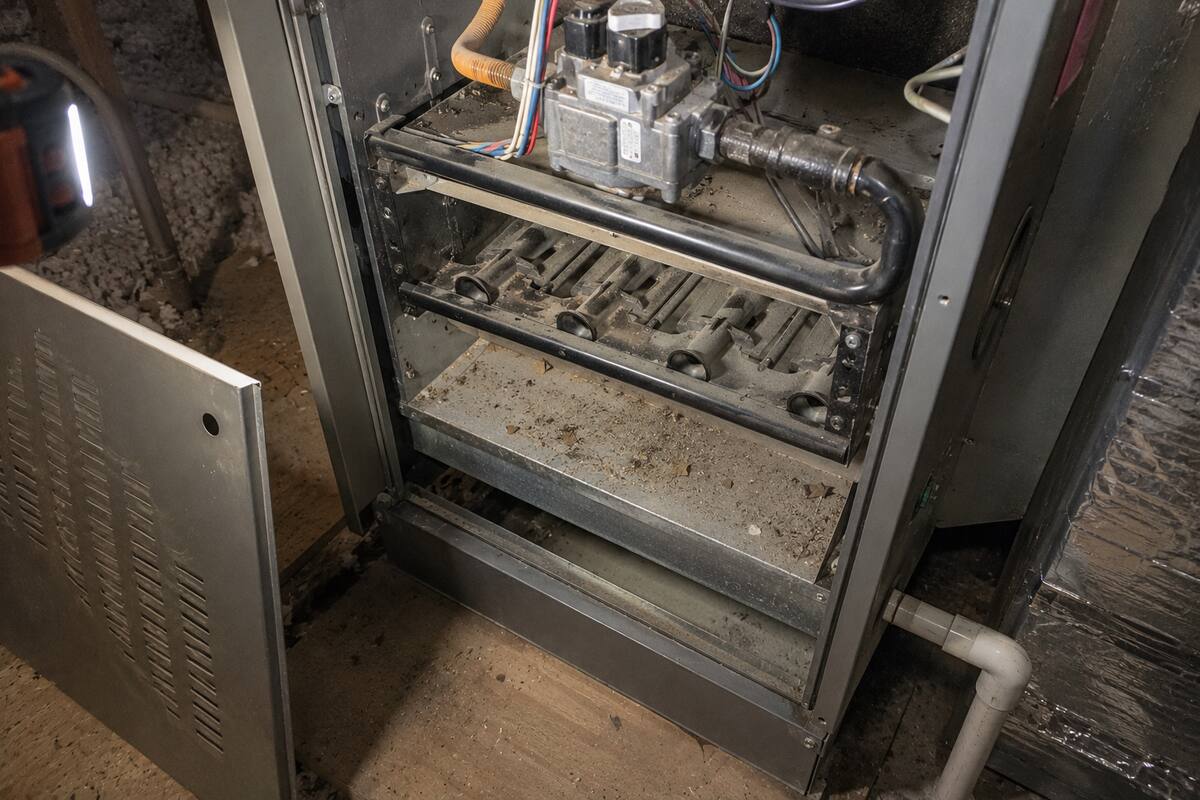
Every other fault on this page produces a cold house. A cracked heat exchanger produces a working furnace with a health problem attached, which is why it is worth stating separately. The heat exchanger is the metal wall between the combustion gases and the air blown through the house; when it cracks, exhaust products can cross into the supply air.
Nothing about that is visible to a homeowner. It cannot be diagnosed from a photo, from the thermostat, or from how the house feels. It requires the system running in heat mode with someone qualified watching it — which is the single strongest argument for an October check in a market where nobody books one. Independently of the system: carbon monoxide alarms on every sleeping level, tested, in any house with gas appliances.
Winter Storm Uri in February 2021 and Winter Storm Enzo in January 2025 are the events people remember, and it is worth being accurate about what they were. Both were overwhelmingly plumbing and water-damage events rather than heating-equipment events — burst supply lines, not failed furnaces. A three-day hard freeze produces a brief unforecastable spike and then passes. The predictable, annual, genuinely under-served window in Houston is the October-to-December ramp, not the freeze.
Because sitting is the stress. Over seven or eight idle months dust settles on the burner assembly and the flame sensor, seals and gaskets stiffen, thermostat calibration drifts, and rodents find a dark, sheltered cavity to nest in. Then on one cold night the system is asked for full output from cold, immediately. Ignition components are the consistently cited casualty, which is a pattern rather than a coincidence.
The degree-day numbers do understate it. Houston recorded 961 heating degree days in 2025 against 4,099 cooling, so the thermal load genuinely is small. But degree days measure load, not service demand, and every residential system in this city provides heat as well as cooling — usually through the same air handler and the same ductwork. The demand is concentrated into a handful of nights rather than spread over a season, which makes it easier to be caught out by, not harder.
The heat exchanger is the metal barrier between the combustion gases and the air being blown into the house. A crack in it can let combustion products, including carbon monoxide, into the supply air. It is invisible from outside the cabinet and cannot be found by a homeowner or from a photograph — it needs someone putting the system into heat mode and inspecting it. Working carbon monoxide alarms on every sleeping level are not optional in a house with gas appliances, and they are not a substitute for having the system looked at.
A flame sensor caked with residue so the control board cannot confirm a flame and shuts the burner down after a few seconds; a failed hot-surface igniter; a pressure switch or blocked flue; a rodent nest in the burner compartment; and thermostat wiring or programming that has been wrong since March and only shows up now. The first two are inexpensive parts, which is part of why an October check pays for itself.
Both are worth the same call. Get connected with an independent Fort Bend County contractor licensed to open the burner compartment and look.
Call (281) 672-8034 Request a Quote Sugar Land