Home › Services › Attic Air Handlers & Drain Lines
Sugar Land houses are slab-on-grade. There is no basement and no crawl space, so the air handler goes in the attic — directly above finished ceilings, producing gallons of water a day for five months of the year. Almost every ceiling stain in this city starts there.
Greater Houston builds on slab-on-ground foundations, frequently post-tensioned. That single construction fact removes both of the places the rest of the country puts an air handler. With no basement and no crawl space, the equipment goes into the attic, and the ductwork goes with it — which is also why duct losses are a bigger deal here than in a market where the ducts run through conditioned space.
An air conditioner does not only cool air; it removes moisture from it. Through a Gulf Coast summer an evaporator coil condenses a substantial volume of water every day, and all of it has to be carried out of the attic by gravity through a PVC line. When that line stops flowing, the water has nowhere to go but down, and what is directly below is a finished ceiling.
The International Residential Code requires secondary or auxiliary drain protection wherever an overflow would damage building components — which describes every attic air handler in Sugar Land. The protection can take more than one form, and a well-built installation has more than one:
A second pan under the whole unit, plumbed to its own line. It catches what the primary system misses. It is also a steel or plastic tray sitting in a hot, humid attic for twenty years, which is why rusted-through emergency pans in 1980s and 1990s First Colony attics are such a common finding.
Usually terminating over a window or a door on an exterior wall. It is deliberately ugly. Its entire purpose is to be seen from the driveway, because the failure it warns about is otherwise silent.
Cuts the system off when water rises in the pan or backs up in the primary line. Comfort is interrupted; the ceiling is not. Many older installations do not have one.
A PVC run with a trap, sloped to drain, ending at a sanitary connection or outside. Biological growth inside it is the usual reason any of the above ever gets tested.
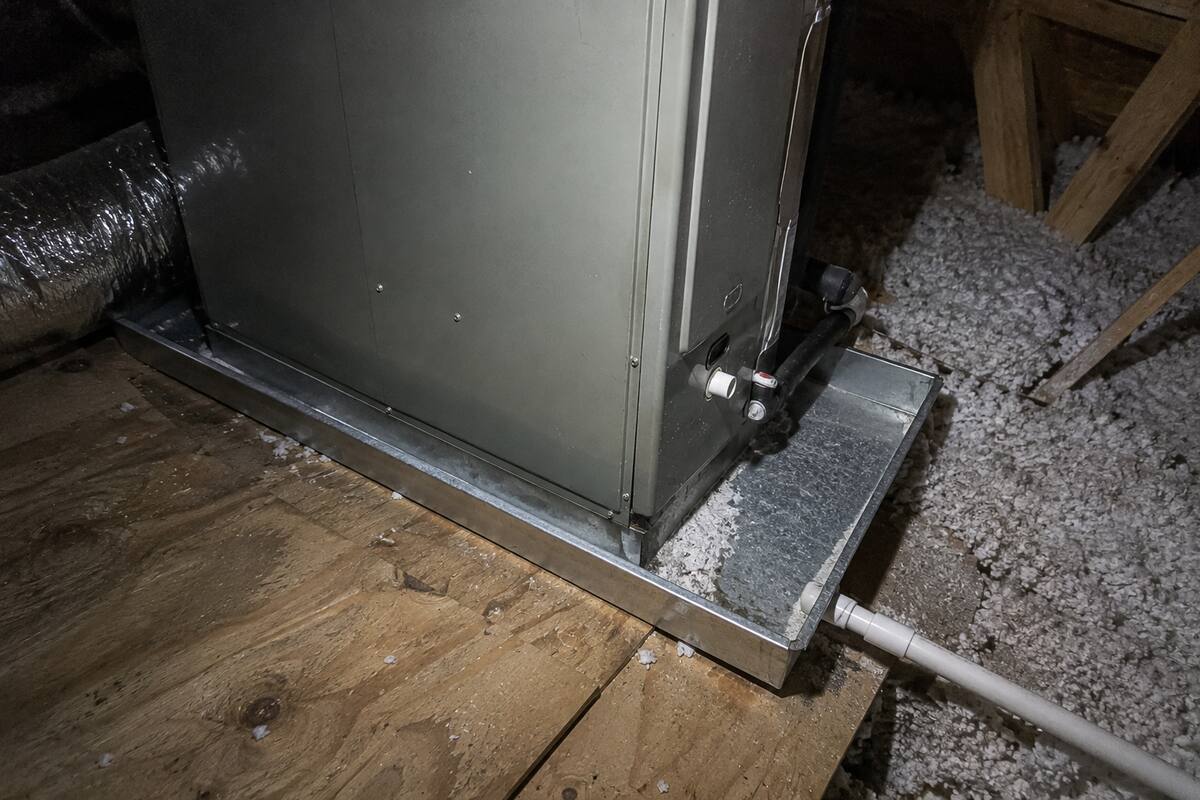
The sequence is consistent enough to be worth knowing. The primary drain line closes off gradually with biological growth over one or two seasons — no symptom at all while it happens. Water then backs up and spills into the auxiliary pan. If the secondary line is clear, it starts dripping over the window; if nobody notices, the pan fills. If the pan has corroded through, or the secondary line is also blocked, the water goes into the ceiling below. If a float switch was installed, the process stops at step two with a warm house and an obvious cause.
In an attic running five-plus months of cooling season, none of the early steps announce themselves. There is no noise, no change in comfort and nothing visible from inside the house. That is the argument for having the line cleared before the season rather than diagnosed during it — see maintenance and tune-ups.
Two-story houses with the air handler over a finished second floor are the worst case, because the water has the least distance to travel and the most to ruin: Sugar Creek's large 1970s and early 1980s two-story homes are the archetype. First Colony, built 1977 to 2000, is where the corroded emergency pan turns up most often, simply because the pans are the oldest still in service. And in Telfair and Riverstone, where houses are on original equipment approaching twenty years, every component of the condensate system is the same age as every other — they tend to reach the end together rather than one at a time.
That is the system working as designed, and it is a warning rather than a fault in itself. The secondary drain line is required to discharge somewhere conspicuous precisely so that a homeowner notices. Water coming out of it means the primary drain has clogged and the auxiliary pan is now doing the work. The cooling still runs, the house is still comfortable, and the only sign is a drip outside — which is exactly why it gets ignored until the pan fills or rusts through.
A small switch mounted in the auxiliary pan or in the primary drain line that shuts the system off when water rises. It is the difference between an inconvenient afternoon and a ceiling repair. Older Sugar Land installations frequently do not have one, and adding one is inexpensive relative to what it prevents. Whether a specific installation needs a pan, a secondary line, a switch, or a combination is a code question for the contractor and the inspector, not a preference.
In this climate, at least annually and realistically before each cooling season. The blockage is biological — a wet, dark, room-temperature PVC line running through an attic grows a slime that eventually closes it. A pan tablet slows it down and does not replace clearing the line.
Not definitely, and this is worth being careful about, because a slab-on-grade house runs three separate water sources through the same attic: the condensate system, the second-floor water supply lines, and whatever comes through the roof. All three produce a brown ring on a ceiling. Ruling in the condensate side is usually quick — a full pan or a wet secondary line settles it — and ruling it out sends the question to a plumber or a roofer instead.
All three point at the same part of the system. Get connected with an independent Sugar Land contractor licensed to open it up and look.
Call (281) 672-8034 Request a Quote Sugar Land