Home › Services › Duct Repair & Sealing
In a slab-on-grade house the ductwork runs through an unconditioned attic that spends five months of the year far hotter than the air being pushed through it. Every leak in that network is cooling that was paid for and never arrived.
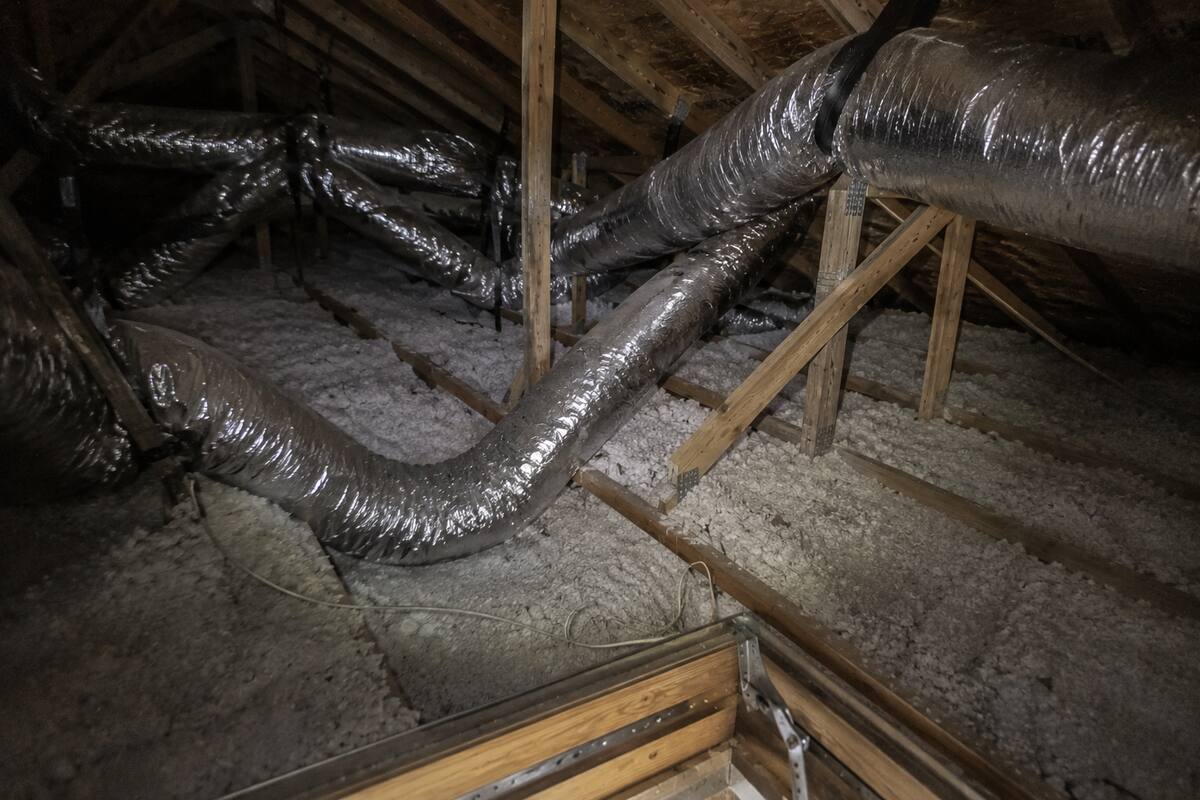
Houses in much of the country run ductwork through basements or conditioned crawl spaces, where a leaking joint loses air into space that is already being conditioned. Sugar Land has neither. Because the foundation is slab-on-grade, the supply and return runs go through the attic — the hottest part of the house through a Gulf Coast summer, and one of the coldest on a January morning.
Two things follow. Air escaping from a supply run is lost outright. And air drawn into a leaking return run is not room air at all — it is hot, dusty, humid attic air, which the system then has to cool and dehumidify before delivering it. A return-side leak is therefore worse than a supply-side leak of the same size, and it is the one homeowners never suspect.
Mastic dries, tape ages, and a flexible duct pulls back off its collar. This is the most common single fault and the most easily fixed.
Flexible duct dipping between joists chokes airflow at every dip. Correct support is cheap and is frequently skipped on production builds.
A run flattened by storage boxes, a repair crew or a later retrofit. It can halve what reaches a room without any visible sign inside the house.
Duct from the 1980s and early 1990s reaches the end of its serviceable life. Sealing a run whose inner liner has failed is not worth the labor.
Attic access via soffit and fascia gaps leads to chewed duct and nesting material inside the run. The same entry route as the burner-compartment problem on the heating page.
Even a sealed duct loses capacity if its insulation has been pulled back for access and never restored. In a 130°F attic that is a real number.
A Sugar Land house that is cold and still clammy usually has one of two causes, and they interact. An oversized system reaches the thermostat setpoint before it has run long enough to pull moisture out of the air. A leaking return does the opposite — it continuously introduces humid attic air that the system then has to dehumidify, so the latent load never falls. Fixing the duct network is often what makes correctly sized equipment behave the way it is supposed to. See also indoor air quality.
The symptoms are indirect, which is why it goes unnoticed for years. Rooms at the far end of the run never quite reach the setpoint; the system runs long cycles and still does not satisfy the thermostat; upstairs is markedly worse than downstairs; the attic pull-down stairs feel cold in August; and dust returns quickly after cleaning. None of those individually proves duct leakage, but together they describe it well. A contractor can measure it rather than infer it.
No, and they solve different problems. Cleaning removes accumulated dust from inside the duct; sealing stops conditioned air escaping from it. Sealing is the one that changes how the system performs and what it costs to run. Cleaning has a narrower case - after construction work, after rodent activity, or where there is visible contamination.
It depends on their age and construction. Flexible duct with an intact inner liner and good connections is usually worth sealing and re-supporting. Duct that has been crushed, disconnected, or has a degraded liner - common in systems from the 1980s and early 1990s - is often past sealing. Sagging runs are their own problem: every dip is a restriction, and a run that sags into a puddle of insulation is doing nothing useful.
It matters most then. A new, correctly sized system connected to a leaking duct network delivers a fraction of what it is rated for, and the homeowner has no way to tell the difference between an undersized system and a leaking one. Whether the ducts are being reused, sealed or replaced belongs in the quote in writing - see AC replacement and installation.
That is usually the duct network rather than the equipment. Get connected with an independent Fort Bend County contractor who will measure it instead of guessing.
Call (281) 672-8034 Request a Quote Sugar Land