Home › Services › Thermostats & Controls
Most control complaints in Fort Bend County are not really control problems. Short cycling, a clammy house at the setpoint and a second floor that never keeps up are sizing and duct problems that show themselves at the thermostat.
A system that starts, runs briefly, stops, and starts again a few minutes later is short cycling. In a hot-humid climate that is a comfort problem before it is an efficiency one, because moisture removal only happens while the coil is cold and wet. Short bursts cool the air without drying it, which is why an oversized system produces a house that is simultaneously cold and uncomfortable.
Oversizing is the usual cause, and it usually arrives by inheritance: a replacement system sized to match whatever was installed in 1994, rather than to a load calculation on the house as it is now. Other causes worth ruling out are a fouled evaporator coil, a restricted filter, a refrigerant charge problem, or a thermostat mounted somewhere unrepresentative — in direct sun, on an exterior wall, above a lamp, or in a hallway that is not where anyone actually sits.
A genuine saving, and the main thing a programmable or smart thermostat delivers. It works because it happens automatically rather than because the control is cleverer than a dial.
A sensor in the wrong place produces the right behavior for a spot nobody occupies. Sun exposure, an exterior wall and a nearby supply register are the three usual offenders.
Motorized dampers and multiple thermostats, sending capacity where it is needed. The standard answer to an upstairs that runs five degrees warm - see Sugar Creek, which is full of large two-story homes.
Longer, gentler run cycles remove more moisture than short bursts at full output. This is the equipment-side answer to the same problem controls can only work around.
An oversized system, a leaking return, a crushed duct run or a fouled coil. A smart thermostat on any of those measures the problem more precisely and does not solve it.
A blank display can be the attic condensate float switch cutting power. That is the safety working. See attic air handlers and drain lines.
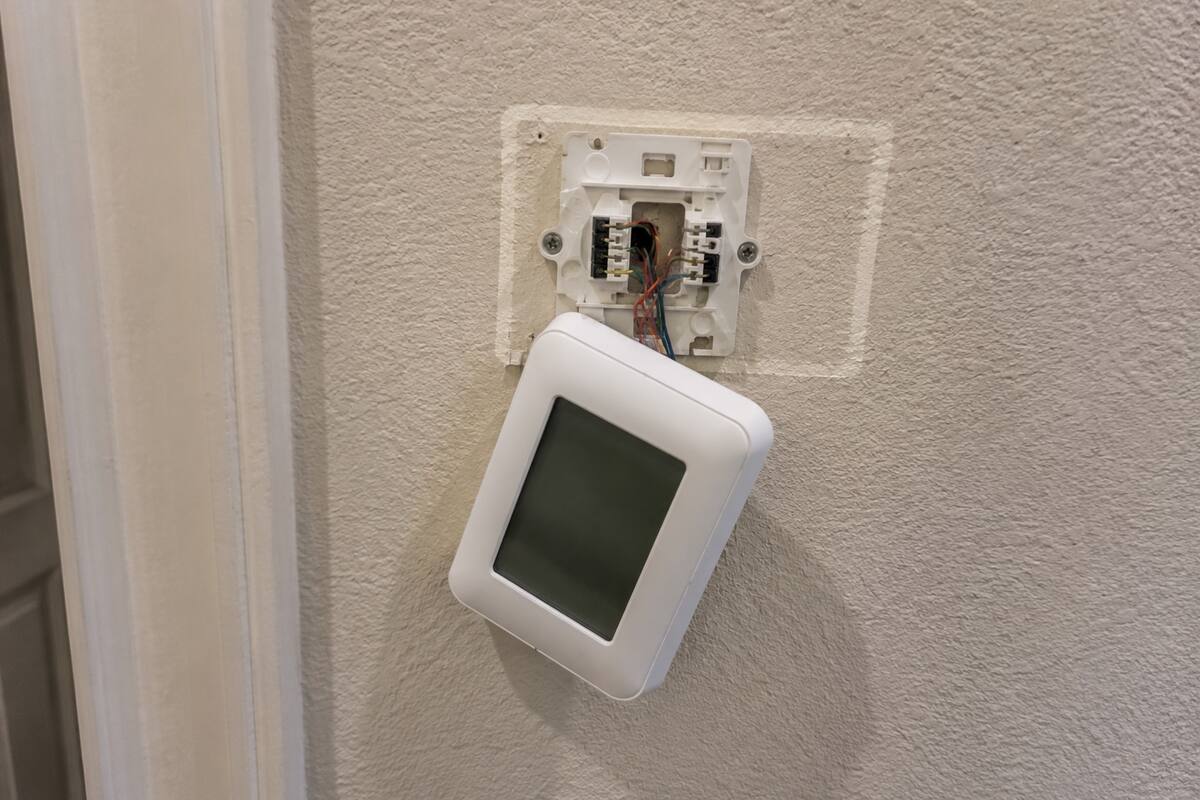
Two checks are worth making, and neither is a repair. First, whether the wiring at the thermostat includes a common wire — many smart thermostats need one, and a lot of Sugar Land houses built before the 2000s do not have one run to the thermostat location. Second, whether the complaint is about temperature or about humidity, because they lead to completely different answers. A house that is too warm has a capacity or airflow problem; a house that is cold and damp has a run-time problem. Only the first is likely to be improved by anything happening at the wall.
Because comfort in a humid climate depends on how long the system runs, not on how fast it can drop the temperature. An oversized unit reaches the setpoint quickly, shuts off, and has removed very little moisture in the process. The result is short, frequent cycles, uneven temperatures between rooms, and a house that is cold and clammy at the same time. It is also harder on the compressor than steady running.
It can, mostly by making scheduling and setbacks actually happen rather than by controlling the equipment better. What a smart thermostat cannot do is fix an oversized system, a leaking duct network or a fouled coil - and a system with any of those will not deliver the savings the marketing implies. It is a good purchase on a healthy system and a distraction on an unhealthy one.
It is one of the better answers to the classic complaint that upstairs is five degrees warmer than downstairs all summer. Zoning uses motorized dampers and multiple thermostats to send capacity where it is needed. It has to be designed properly, though - a zoned system needs somewhere for the air to go when zones close, and a bypass arrangement done badly creates its own problems.
It can be either, and it is worth checking the simple things before the call. A blank display can mean dead batteries in a battery-powered unit, a tripped breaker on the air handler circuit, or a float switch in the attic that has cut power because the condensate pan filled - which is exactly what it is designed to do. That last one is common in Sugar Land and it is the system protecting your ceiling rather than a fault.
Both are usually about capacity and ducts rather than the thermostat. Get connected with an independent Fort Bend County contractor who will check the whole chain.
Call (281) 672-8034 Request a Quote Sugar Land